
Know which devices are running at home
An AI energy monitor in your fuse box. It recognises ten appliance types, and it learns devices it does not know yet.
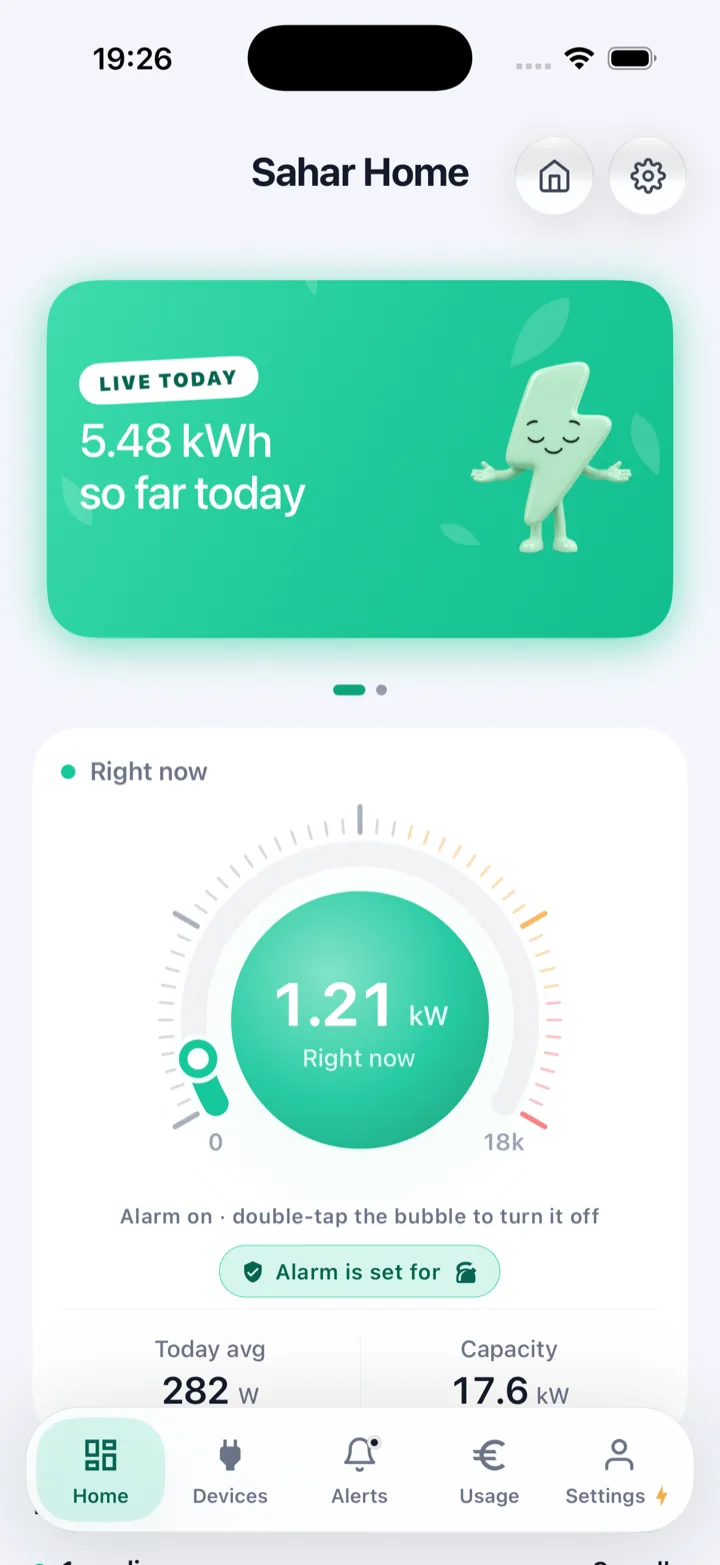
- See which appliance types are on, live
- Alerts when something is left on
- No smart plugs, no subscription
- Patent-pending AI and sensor

What you’ll notice
- Iron is off
Checked on your phone at the door.
- Kids are back
TV on at 15:10, microwave at 15:25.
- Cooktop still on
Running for 2 hours. Nobody is home.
- Mum’s morning tea
Kettle on at 8:12, as every day.
- Heater on all night
Ran 8 hours, from 23:00 to 07:00.
- AC while you’re away
Running since 9:00. Home alarm is on.
Health checks and tips
It notices when an appliance changes.
- 45 WStandby all nightTV box and router, every night.
- +30%Fridge working harderLonger runs than last month.
- +15%AC filter needs a cleanMore power for the same cooling.
- +20%Water heater ageingSlower to heat than when first seen.
Estimates from the power patterns the sensor sees. Examples shown.
More in the app
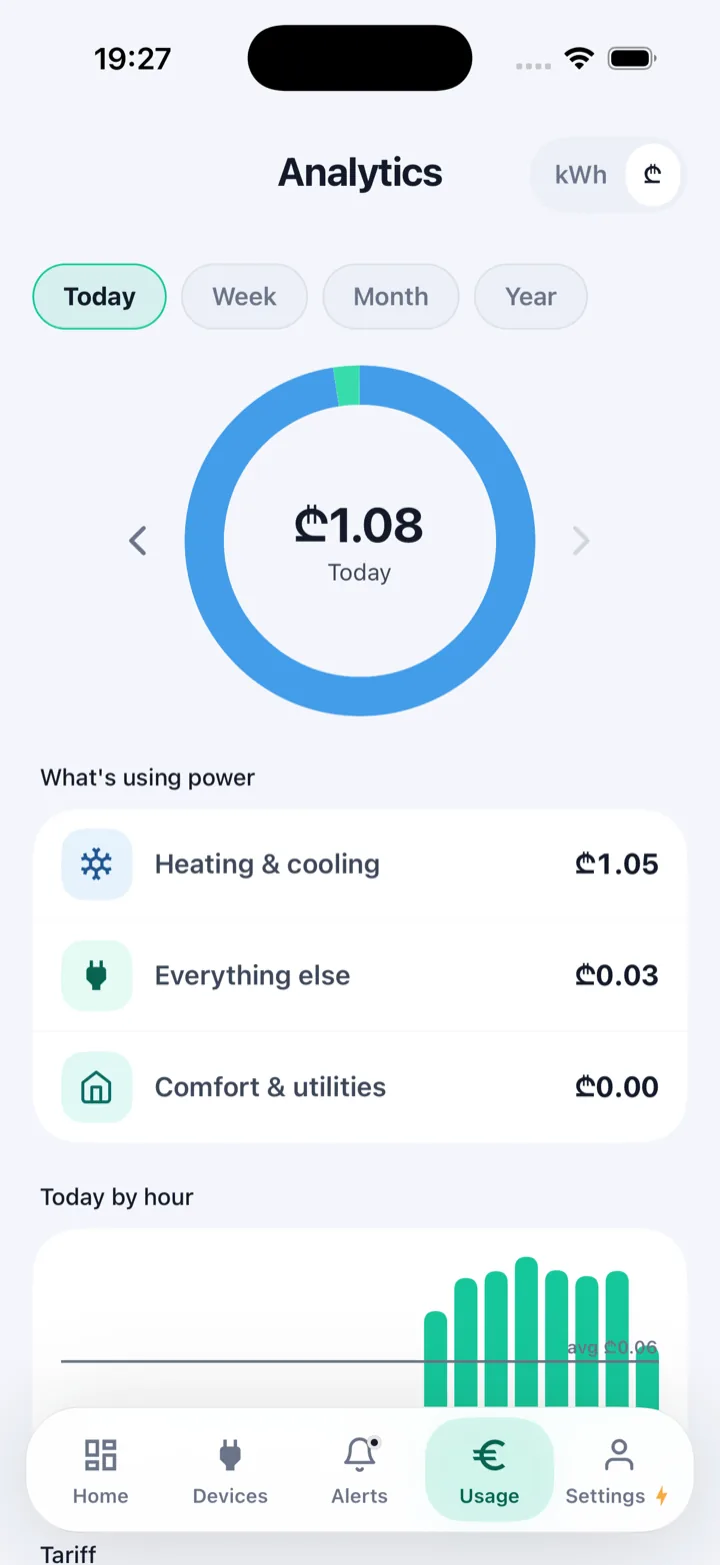
Ten appliance types
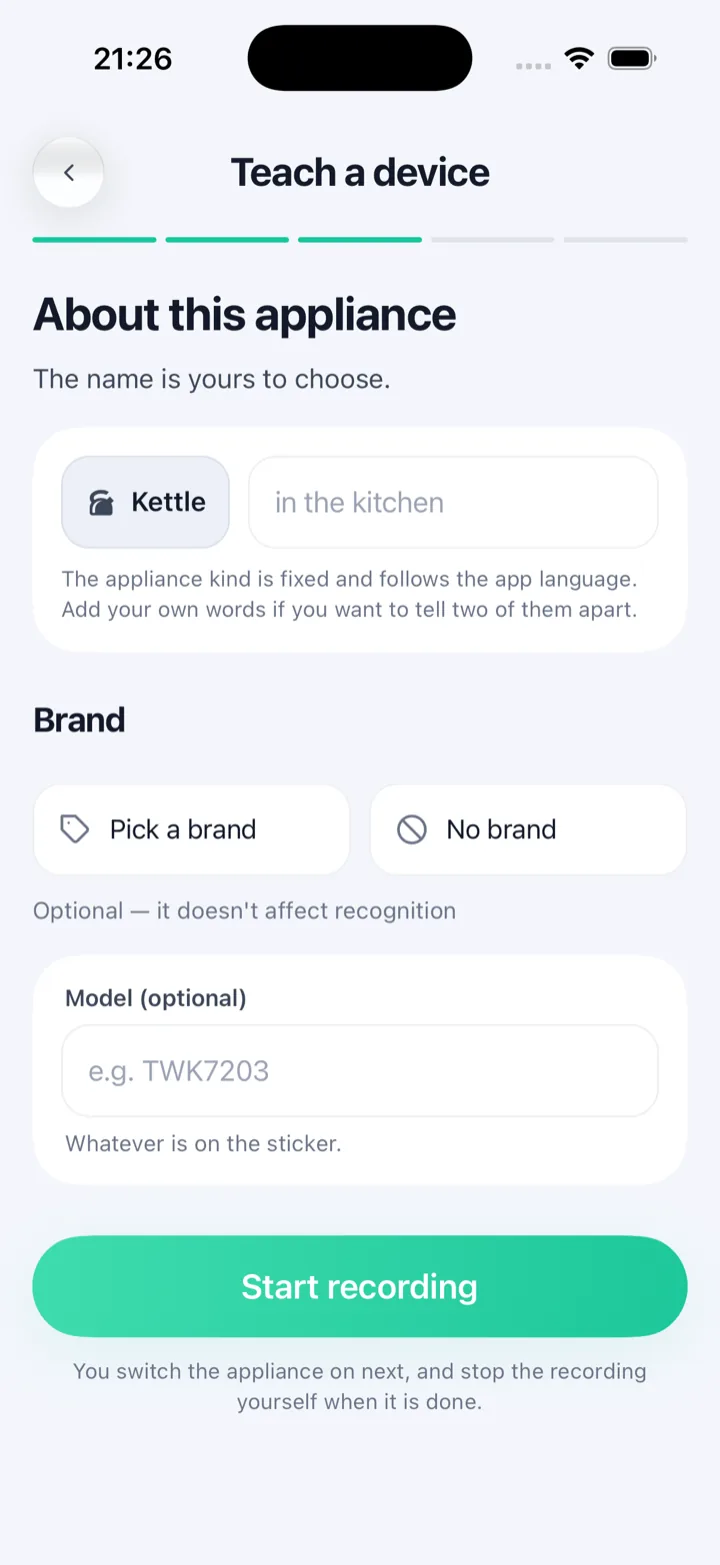
Teach it devices it does not know yet.
- Air conditioner
- Electronics and lighting
- Fridge
- Heating
- Cooktop
- Microwave
- Motor
- Washing machine
- Water pump
- Everything else
- 6 mmOn the DIN rail
- 1Phases
- 17 kWUp to 75 A
- 2 yearsWarranty
Fit it in eight steps
You or an electrician. The incoming cables stay live, so if you are unsure, ask an electrician.
Questions
Not here? ilia.kamyshev@iesllc.ge
Is the sensor and the app the whole product? Is anything else needed?
The box contains the sensor, a voltage lead with an inline fuse and a current clamp. You also need a 50 Hz supply, 2.4 GHz Wi‑Fi at the panel and someone competent to fit it. Installation.
What appliances can it detect?
The model estimates supported household load categories. Teaching is a feature: the sensor learns devices it does not recognise yet. Results depend on the appliance and other loads running at the same time, so recognition should be checked during a pilot.
Can it tell one light from another, or appliances from different brands?
Not one by one. The sensor measures the total on the monitored phase and estimates ten built-in load categories, such as air conditioner, fridge, washing machine and ‘electronics & lighting’, so several lights, or two fridges, are reported together in their category. When it meets a device the model does not recognise yet, teaching makes the sensor learn it. Brand does not matter.
Can you control devices with it?
No. Visiwatt measures and tells you; it does not switch anything on or off. There is no relay in it, and it is not a smart plug.
What is the point if there is no control?
Because most waste is not something you would have switched off — it is something you did not know was happening. An air conditioner running in an empty house, a fridge that quietly started drawing more than it used to, a heater on a timer nobody reset. Control assumes you already know what to switch. This tells you what is actually running and what it costs, and then you change the schedule, service the appliance, or change the habit. It also means nothing in your home can be switched by mistake, or by anyone else.
Is an electrician required for installation?
Not always. The sensor fits inside the consumer unit with the main breaker off. Fit it yourself if you are confident working in the panel and local rules allow it; otherwise ask a qualified electrician.
Does it work for apartments and houses?
Both. Flats usually have one phase and houses often three; the sensor supports both at 50 Hz. It needs 6 mm of free DIN rail beside the main breaker.
Does it work without internet?
Measurement and recognition run on the sensor and continue when the connection drops. Stored readings can be uploaded after reconnection, within the sensor’s storage capacity. App history, account access and remote alerts use the cloud service and need connectivity. The current release has no local-only switch in Settings.
What if my sensor stops working?
It carries a two-year warranty. The appliance templates it has learned live on the device, so a replacement has to learn your home again; anything you synced to the cloud comes back with your account. If something looks wrong, write to ilia.kamyshev@iesllc.ge before an electrician touches the panel.
Is it secure? What data do you actually get?
Recognition happens on the sensor, not in our cloud. Your data is protected and is not shared beyond the services that run Visiwatt. What we hold is your account, the home details you add in the app, and your energy data: the power drawn at your panel, the appliance events the sensor recognises, and the names you give them. Learned recognition data is used on the sensor, and a copy is kept in the cloud with your account. Energy readings, appliance metadata and diagnostic recordings can also be handled by the cloud service. We do not sell your data; it is not part of the business model. Read more in the privacy note.
Can I get my data out, or delete it?
Contact ilia.kamyshev@iesllc.ge to request a copy of your data; the current app has no self-service export. Account deletion starts the cloud-data erasure process. The full detail is in the privacy note.
Pre-order
Pay by bank transfer. We email you the invoice and confirm your order when the transfer arrives.